
¡How badly the <insert variety here> speak! (II) El yeísmo rehilado. That is, me.
have a friend who always says that, in any situation, it's better to be in second place than in first, because many people want to knock down the person in first place, while the person in second place... gets ignored. In other words, it's better to go unnoticed than to be the one everyone's looking at. And I'm lucky to be Uruguayan, and regarding the linguistic phenomenon we'll discuss today, we Uruguayans are in second place... out of two. We are so few in such a small country by Latin American standards that we simply go unnoticed. No one mentions us in the "fights" that happen online between Latin Americans about how words are pronounced, about what to call palta or aguacate (avocado), etc. Except to call us Dinoguay in soccer memes. Dino from dinosaur (dinosaurio), because we won our last World Cup when Cleopatra was ruling Egypt. Were there still dinosaurs at that time? We get "ignored" because we're a small country, and because Argentina exists. Argentinians are one of the best things that could have happened to us Uruguayans. There are many more of them than us - 44 million versus 3.4 million - a huge country with a reputation for being arrogant. We are a scarce commodity; when people hear us speak in other Spanish-speaking countries, they usually ask if we're Argentinians. In fact, out of the thousands of times someone has asked me my nationality, only once did someone ask "Argentinian or Uruguayan?" And we have a reputation for being humble. For being nice guys :). The fact is that, in reality, Uruguayans and Argentinians are basically the same people and we share a phonological trait, the yeísmo rehilado, which occurs throughout Uruguay and in parts of Argentina, mainly in the littoral region, Buenos Aires, and southern Argentina. The thing is that all the criticism for this way of pronunciation on the Internet goes to the Argentinians, and we go unnoticed. So, in this new article in this little series, we'll see how badly Argentinians speak 😉 and this time I'll be able to give you pronunciation examples, because I'm a specialist.
El yeísmo rehilado is, moreover, one of those characteristics of the Spanish language, like lambdacism, which we saw in the previous article of this series, that makes people who speak other varieties of the language consider that those of us who speak this way speak badly. Just a few days ago, I made a comment on a video from a Spanish language channel that I love, and I had the following exchange:
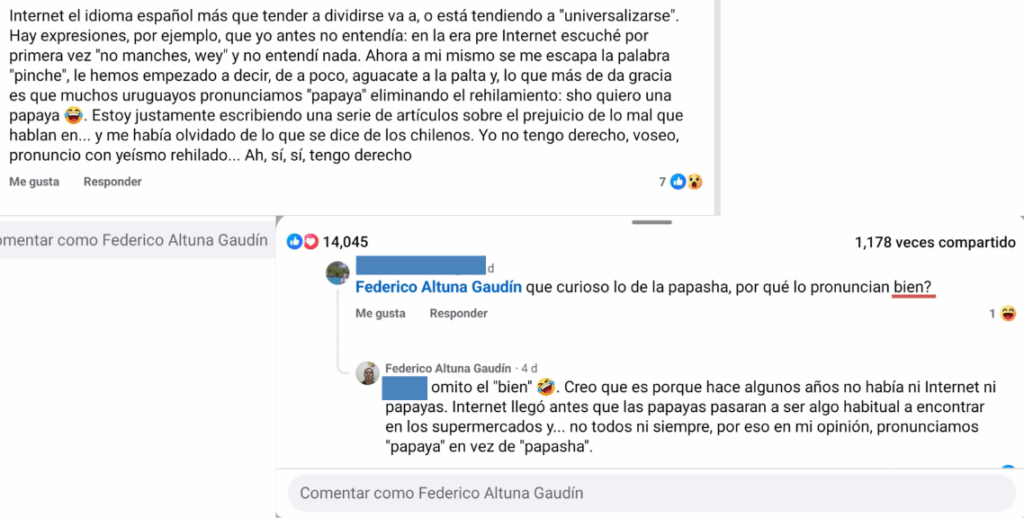
It’s a real exchange. These are screenshots from my Facebook profile – yes, Federico Altuna Gaudín is me. I covered the name of the person who made the comment to me because it’s clear they didn’t do it maliciously, but out of curiosity, because my idea with this blog is to share my language and culture and not bother anyone, and because I know this is the reality: even many people who speak my variant of the language think we speak badly. I myself thought so, until I started delving into languages, and started learning my own language, and was able to understand that, in linguistics, it’s actually very difficult to assert that something is wrong. Because one speaks as one speaks where one lives. And in phonetics this is even more difficult, in my opinion. If tomorrow I stopped pronouncing y and ll with rehilamiento while living in my country, no one would tell me I had improved my Spanish – no, on the contrary, they would probably make fun of me. Because this is how we speak, it’s our variety of the language, and if I tried to modify it to sound more “neutral” I would be doing something artificial. Something false.
The RAE Dictionary defines yeísmo as the “disappearance of the phonological difference between the palatal lateral consonant and the voiced palatal fricative, so that, in pronunciation, words like callado (quiet) and cayado (shepherd’s staff) are not distinguished”. That is, yeísmo implies that y and ll are pronounced the same way. Yeísmo is a very widespread phenomenon in current Spanish: broadly speaking, in some Andean regions and in some parts of Spain, the phonological distinction is preserved, and generally these are regions with influence from other languages – Amerindian in America and Spanish regional languages in Spain. The sound that was lost in yeísta zones is the lateral palatal consonant, which corresponded (and corresponds in non-yeísta zones) to that of ll, and the most… neutral… standard pronunciation… actually I don’t know what word to use, would be the voiced palatal fricative, although this sound can be approximant rather than fricative in articulation and sound almost like the i. It should be noted that in the case of y, we’re referring to ys that go at the beginning and in the middle of words. The y at the end of words, as in rey (king), and the conjunction y (and) sound like the vowel i.
Let’s use the words that the RAE uses in its Dictionary to hear these sounds. It’s me speaking. To get the awkwardness over with quickly, let’s first listen to the lateral palatal consonant sound, which although it’s a sound that belongs to my language, is very foreign to my variety of it, and I find it difficult to pronounce. If a Catalan hears this audio, they’re free to laugh.
Callado.
Now let’s listen to the palatal fricative consonant sound:
Cayado.
In the case of my linguistic variety, there exists rehilamiento, a phenomenon by which friction is produced in the articulation zone, and it’s also a yeísta variety, so y and ll are pronounced the same way. There are two variants: it’s pronounced as a voiceless postalveolar fricative [ʃ], which is a sound similar to the sh in the English word “show”, or as a voiced postalveolar fricative [ʒ], which is a sound similar to the French j in je (I). The latter is more characteristic of higher socioeconomic strata, and the former, the voiceless postalveolar fricative, is more widespread in areas where rehilamiento occurs. Let’s listen to examples:
Voiceless postalveolar fricative (the pronunciation is the same for callado and cayado).
Voiced postalveolar fricative (the pronunciation is the same for callado and cayado).
Let’s see another example with a sentence and the three forms of pronunciation.
Yo sé que la playa está llena de gente. (I know that the beach is full of people.)
Yeísta pronunciation with palatal fricative consonant sound:
Yeísta pronunciation with rehilamiento and voiced postalveolar fricative consonant sound:
Yeísta pronunciation with rehilamiento and voiceless postalveolar fricative consonant sound:
In my variety of the language, we also use voseo. Here you can read more about what voseo is. Explained quickly, it involves changing the pronoun tú (you) to the pronoun vos and some changes in verbal conjugation, specifically in the second person present indicative (vos caminás instead of tú caminas – you walk) and in the positive imperative (caminá instead of camina – walk!). So yes, my variety of the language involves some challenges. The important thing, as a concept, is something I always repeat in this blog: beyond the fact that differences exist between different varieties of the Spanish language, these don’t prevent communication at all. Apart from some confusion that’s generally funny due to the different names we give to some things or the different use of some verbs, communication between Spanish speakers flows without problems. I say this from experience: I’m lucky to have spoken with natives from almost all Spanish-speaking countries and we never had problems understanding each other. I hope these lines have been interesting to you. Thanks for reading!


Leave a Reply