
¿Eres feliz o estás feliz? The verbs ser y estar

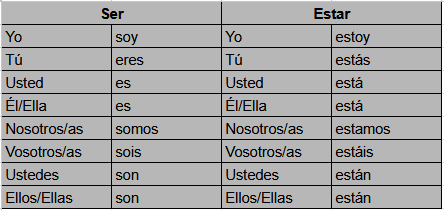
ne of the biggest headaches for those learning Spanish as a foreign language is the difference between ser and estar. And it's understandable. While this differentiation is not exclusive to Spanish, it is widely used in our language and, if you come from languages that don't have it, it can be difficult to understand. Or rather, to use, because the rules themselves are few and clear. But this is something that requires practice, practice and more practice because, of course, you can't be thinking about rules when you want to maintain a conversation. So, in this article we will see the conjugation of both verbs in the present indicative, the rules, broadly speaking, to know when to use one verb or the other, and examples of use. The existence of both verbs has its origin in Latin and its evolution to the Spanish language. A review of this origin will be left for another article. It's interesting, it can help understand why both exist but, on one hand, it's a lot of information and, on the other, you can learn to use these two verbs without studying History. Let's go!
I’m going to present here some concepts that, while they may seem contradictory and even boring, I believe are useful and fascinating :). If you don’t want to read about semantics concepts and things like that, skip this paragraph. But if you’re a nerd like me, keep reading. In this article you can read a bit more about the perfectivity and imperfectivity of preterite tenses in Spanish. When we see this same aspect with the verbs ser and estar, however, the explanation may seem a bit contradictory. Ser feliz (to be happy) is semantically perfective because the situation of ser feliz is inherent to the being that is, it doesn’t depend on a process, that is, it has no beginning because whoever es feliz is so, from a strictly semantic point of view, from always and, while it has no end as such, it does have one, because who es feliz will be so until the end. Estar feliz, on the other hand, depends on a process, on something that happened. Estar is semantically imperfective because it depends on a process, an event, a becoming, something that caused the happiness, and that is happening, is in process, and although it can change at any moment, we don’t know if it will change or not, so from a strictly semantic point of view we do not know if it has an end. So, the general rule is that for characteristics inherent to the person, or to the noun, to be more precise, we use ser, and for states we use estar. This as a general rule.
Uses of ser.
Identity and permanent characteristics: the verb ser is used to identify who or what someone or something is, as well as to indicate permanent characteristics of someone or something.
Yo soy Federico. (I am Federico.)
María es alta. (María is tall.)
Las manzanas son frutas. (Apples are fruits.)
El agua es transparente. (Water is transparent.)
Profession:
Él es médico. (He is a doctor.)
Nosotros somos profesores. (We are teachers.)
Nationality and origin:
Yo soy uruguayo. (I am Uruguayan.) To introduce the country of origin, we use ser + de: yo soy de Uruguay (I am from Uruguay.)
Time and dates:
Son las cuatro menos cuarto de la tarde. (It’s a quarter to four in the afternoon.) Note: es la una de la tarde (it’s one o’clock in the afternoon.)
Mañana es sábado. (Tomorrow is Saturday.)
Hoy es cuatro de Julio. (Today is July 4th.)
Location and date of events:
¿Dónde es el concierto? En el centro de la ciudad. (Where is the concert? In the city center.)
¿Cuándo es el concierto? El sábado. (When is the concert? On Saturday.)
La fiesta es en la casa de Luis. (The party is at Luis’s house.)
Description of personality and qualities of objects:
Ella es muy inteligente. (She is very intelligent.)
Vosotras sois muy generosas. (You all are very generous.)
Yo soy bastante tímido. (I am quite shy.)
Mi auto es blanco. (My car is white.)
Las paredes de la casa son verdes. (The walls of the house are green.)
Personal relationships or kinship:
María es mi tía. (María is my aunt.)
Nosotros somos amigos. (We are friends.)
Quantity or price to pay:
En mi casa somos cuatro. (In my house we are four.)
¿Cuánto es? Son 22 euros. (How much is it? It’s 22 euros.)
Material and composition: we use ser + de:
Esta camisa es de algodón. (This shirt is made of cotton.)
Las sillas son de madera. (The chairs are made of wood.)
Ser joven (to be young): ser pequeño (to be small), ser grande (to be big), ser adulto (to be an adult), while these are characteristics that will change with the passage of time, they are characteristics inherent to the being in the stage of life they are going through. Thus, although it may seem contradictory, to introduce these stages of life we use the verb ser.
Uses of estar.
Temporary physical or emotional states:
Ella está resfriada. (She has a cold.)
Hoy estamos muy cansados. (Today we are very tired.)
¿Cómo estás hoy? Estoy muy bien, ¿y tú? (How are you today? I’m doing very well, and you?)
Temporary states or conditions:
El coche está roto. (The car is broken.)
El café está muy frío. (The coffee is very cold.)
La sopa está caliente. (The soup is hot.)
Location or placement of something or someone:
¿Dónde están mis llaves? Están sobre la mesa. (Where are my keys? They are on the table.)
¿Dónde estás? Estoy en mi casa. (Where are you? I am at my house.)
Mis padres se fueron de viaje, ahora están en Austria. (My parents went on a trip, now they are in Austria.)
¿Dónde está París? Está en Francia. (Where is Paris? It is in France.)
As a general rule, we can base ourselves on the previous examples: if we are going to introduce a characteristic of something or someone we use ser, if we are going to introduce a state we use estar. Regarding locations, if we want to introduce the location of an event we use ser, and if we want to introduce the location of a place, city, country, etc., we use estar.
The contrast between ser and estar.
In many cases you can use ser or estar with the same word, something that changes, so to speak, the temporality of the meaning. Let’s see examples.
Ella es muy elegante. (She is very elegant.) Always, she dresses very well.
Ella está muy elegante con ese vestido. (She looks very elegant in that dress.) Today in particular.
Yo soy muy delgado. (I am very thin.) Always, it’s a characteristic of my person.
Yo estoy muy delgado. (I am very thin.) Denotes a change, I have lost weight.
Él es muy alegre. (He is very cheerful.) Always, he is a person with, for example, constant good humor.
Él está muy alegre. (He is very cheerful.) Today, because, for example, something happened that caused him joy.
In other cases, the use of ser or estar with the same word completely changes the meaning:
Ser bueno: to have goodness as a personal characteristic, or to be very skilled at performing an activity. Estar bueno: refers to the physical attractiveness of a person, that is, saying that someone está bueno means that we find them physically attractive, to the flavor of food, saying that a meal está buena means that we like it, or to the quality or attractiveness of something, saying that a movie está buena means that we like it.
Ser malo: to have wickedness or bad behavior, to be of poor quality or to be very unskilled at performing an activity. Estar malo: to be sick.
Ser listo: to be intelligent. Estar listo: to be ready.
Ser rico: to have a lot of money. Estar rico: to be tasty (food).
Ser aburrido: if it refers to an activity, it means that it is tedious, that it causes boredom. If it refers to a person it means that they are dull, that they don’t know how to have fun. Estar aburrido: to feel bored, to have nothing to entertain oneself.
Ser verde: to be that color. Estar verde: to be unripe. It mainly refers to fruits and vegetables, but can be used to refer to people in a figurative sense.
In the particular case of estar muerto (to be dead), something that sometimes leads to confusion, the verb estar is used since being dead is not an inherent characteristic of beings, but rather a result of a process, that is, beyond the fact that it is something that will not change, from a grammatical point of view it is a state.
This is only the first article about these verbs so widely used in Spanish and that generate so many doubts for those acquiring the language. Here I leave you exercises to practice this topic. Thanks for reading!


Leave a Reply