
Me voy a ir yendo: Leaving an Event in the Spanish-Speaking World

nlike other cultures where someone who wants to leave a place simply says goodbye, or "I'm leaving," or something similar, gets up and leaves, in the Spanish-speaking world this is usually not the case. It's a process that involves goodbyes, more goodbyes, often having someone prepare a to-go package with some food for you, more goodbyes after that, and then waving goodbye from the street. Yes, leaving is a ritual that can take between 20 minutes and half an hour or even longer, and you need to keep this in mind if you need to leave one place to arrive somewhere else at a specific time. Or if you simply feel like leaving a place. In this article, we'll briefly review this ritual so that if you're ever at a social event in a Spanish-speaking country, you'll be aware that, depending on the culture you come from, leaving might not be as easy as you're used to.
The first thing to understand about why this happens is that, despite the fact that individualism is advancing in Hispanic societies as it is in many societies, and despite the fact that when we talk about Hispanic culture we’re encompassing many very different cultures, something we Hispanics have in common is a culture of closeness. Hispanics touch each other a lot, we hug, we use fewer polite formulas in speech than people from other cultures because politeness maintains distance, and especially when we find ourselves in non-Hispanic countries, we become friends in an afternoon. Family – but extended family – and friends are very important to Hispanics, and we even have the word sobremesa (the time spent lingering at the table, chatting after a meal) to refer to the time we stay at the table, talking, after eating. So when we want to leave an event – and I’m using the word event because it encompasses many things, but such an event could simply be dinner with friends – the people who are there need to let us know that they don’t want us to leave. And since it’s a cultural fact, whoever wants to leave knows this is going to happen when they announce they’re leaving.
A frequent question among Spanish language learners is the difference between ir and irse. And this difference is quite simple: ir means to go toward a place, irse means to leave a place. And one of the typical Spanish phrases that generates the most memes is one we habitually use to initiate the ritual of leaving a social event: me voy a ir yendo. This phrase is an example of a verbal periphrasis (here you can read more about what a periphrasis is), which broadly speaking is a group of words that, complementing each other, convey a single meaning. Me voy a ir yendo means I’m leaving… but it really means I’m going to start leaving. Because yes, when we want to leave a social event, we know it will be a process.
When someone at a social event in the Spanish-speaking world announces that they’re leaving (se va a ir yendo), the protests begin – for example, that it’s very early, that there’s no work tomorrow, etc. – the proposals – for example, “have one more beer before you leave”, which is generally accompanied by serving you that beer – and, in many cases, the alternatives: someone who tells you they have to leave in an hour and invites you to leave together, even though you both live on opposite ends of the city and both came in your own cars. This is the first step where the goodbye is generally prolonged: it’s very common for us to accept one more beer or to leave together with whoever is going to leave later.
After one of these concessions comes saying that now we really are leaving: one says something like Bueno, ahora sí me voy (well, now I really am leaving), and gets up from their seat. At that moment, everyone present is greeted, generally with a hug and comments about how nice it was to get together, and finally, it’s time to say goodbye to the hosts, commenting again on how lovely the gathering was. Generally, the guest thanks them for the invitation, the host thanks them for coming, and in many cases, the host prepares a tupperware container of food or something like that for the guest to take. Then, whoever is leaving makes like a general goodbye to the whole group, everyone promises that the gathering will be repeated soon, and then a group of those staying – when not all of those staying – accompany whoever is leaving to the street. Once on the street, there’s a new round of hugs, and once whoever is leaving is in their means of transportation, those staying and whoever is leaving wave goodbye to each other once more.
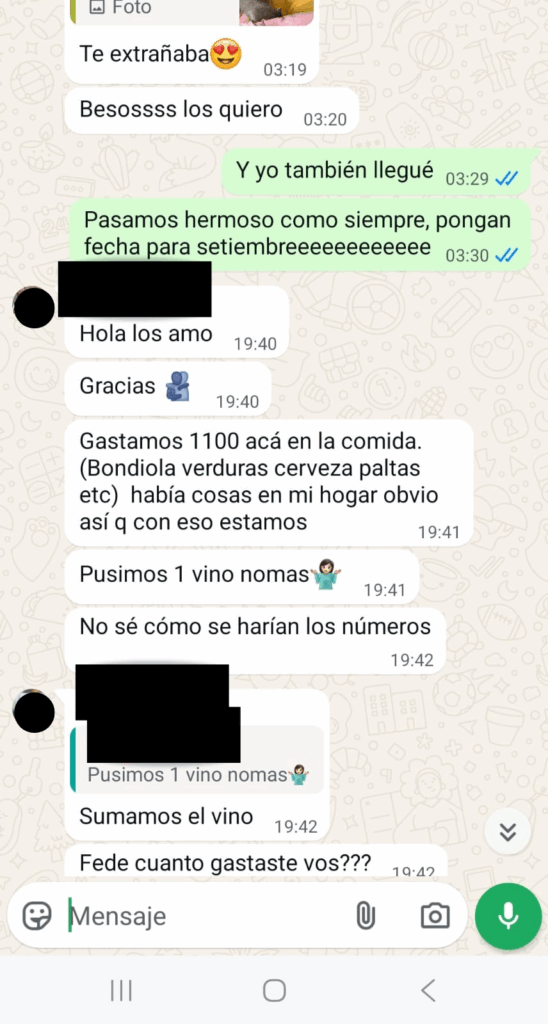
Until a few years ago, this was how it was. Now it’s worse, because every gathering has a WhatsApp group. Hispanics, and Latin Americans in particular, are not very punctual and are quite disorganized. The WhatsApp group serves to agree on the meeting place, what needs to be bought for it, to let everyone know we’ve arrived when we’re at the door (because why would we ring the doorbell?), to eventually split expenses after the gathering, and to let the group know that we’ve arrived at our homes after the gathering and, once again, say goodbye. And, of course, to plan the next one. I’m leaving you a screenshot from my own WhatsApp so you can see I’m not lying :).



Leave a Reply