
Relindo or re lindo? This time, dear Real Academia Española, I’m going to push back a little.
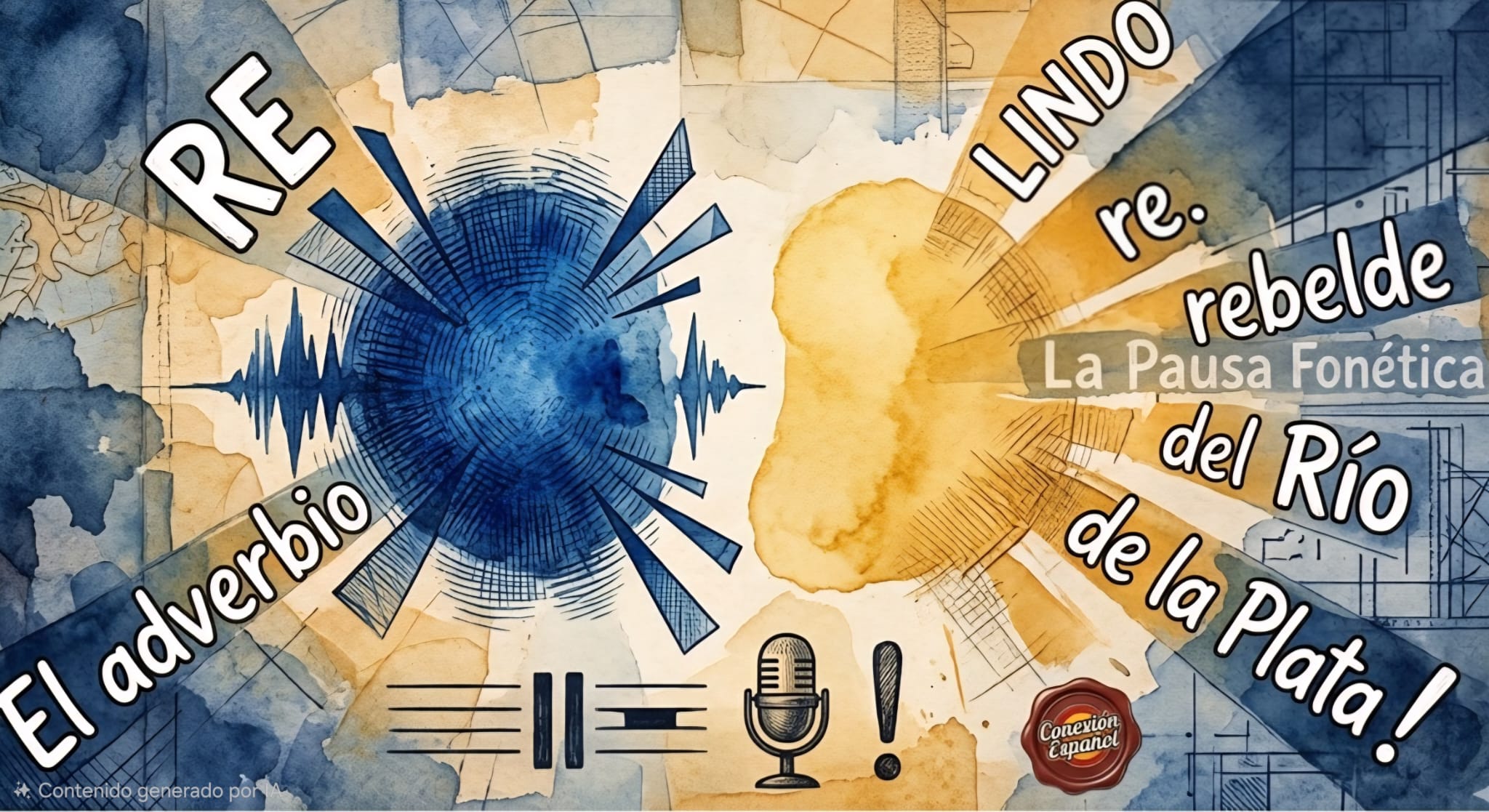
ote: colloquial language. I’ve been wanting to sit down and write an article about the particle “re” for a while now. The RAE (Royal Spanish Academy) defines it as an intensifying prefix, that is, a prefix that intensifies an adjective: relindo means muy lindo or lindísimo (“very pretty”). Being a prefix, it must be written - according to current normative rules - attached to the adjective it intensifies, forming a single word: relindo. The “problem” I’m bringing you today is that “re”, from my humble point of view and in my variety of the language, is not a prefix. It’s a rebellious adverb that, on top of that, has been used around here for many years. And since I’m a phonetics enthusiast, I’ll also show you with audio clips how “re” is used in my variety of the language. One thing I can assure you: if you ever visit Uruguay or Argentina, or if you’re in contact with any speaker of our variety, “re” is something you’ll hear all the time. Let’s go!
Relindo or re lindo?
In the Nueva gramática de la lengua española, the RAE refers to the use of re- as a prefix in the following way:
“A very notable increase of these derivatives has been observed in the youth language of the Rioplatense area (and, to a lesser extent, in the Chilean area), where it extends to adjectives with which it is unusual in other areas, such as in regrande, redivertido, reimportante, redenso, relindo [‘really big, really fun, really important, really dense, really pretty’]. This value is also productive […] or even requerer (‘to love a lot’).”
Source: https://www.rae.es/gramática/morfología/prefijos-gradativos-y-escalares
As far as its use with adjectives or adverbs goes, yes — re in my variety of the language functions as an intensifier. So, at first glance, it might seem to make no difference whether it’s written as a single word together with the adjective it intensifies. The problem is that, around here, re has “gone independent”. This involves a change in pronunciation — which can be very subtle for someone acquiring the language, just like the intonation difference between por qué (“why?”) and porque (“because”) — but also something deeper: re stops behaving like a prefix and begins to function as an independent intensifying adverb, equivalent to muy (“very”) when used with adjectives or adverbs. From a linguistic standpoint, this represents a prosodic and morphosyntactic shift. And there are semantic nuances too. Let’s turn to a colloquial example and a Spanish word that genuinely contains the prefix re. In our variety of the language, estar seco colloquially means to be broke (lit. “to be dry”). So estar re seco (“to be really broke”), in the colloquial sense, semantically intensifies the idea of having no money: it means something like having absolutely no money and no prospect of having any in the near future, to try to put it into words. Estar reseco, on the other hand, means — according to the RAE dictionary — to be excessively dry, that is, severely dehydrated. And that is also what we understand here when someone says reseco instead of re seco. I’ll let the audio clips speak for themselves.
Está reseco
Está re seco
Did you notice the pause in re seco? Re is used to intensify, and in our variety of the language it is pronounced emphatically — and in many cases with a brief pause between re itself and the word it intensifies. This is precisely why I argue that, in our variety, re has “gone independent.”
Re quiero escribir el artículo. (I really want to write the article).
Re can also function as an intensifier with verbs — something that is not common in other varieties of Spanish. In many cases it is equivalent to mucho (“a lot”) or realmente (“truly/really”); in others, it conveys something like “really wanting to do something” or “doing something wholeheartedly.” Let’s look at another example. The verb requerir means “to require”: requiero que escribas el artículo (“I require you to write the article”). In contrast, re quiero que escribas el artículo expresses something completely different: that I really, really want you to write the article. Once again, the difference is not just in the pronunciation, but in how re behaves: it stops being a prefix and starts functioning as an independent element with an intensifying value.
Requiero que escribas el artículo
Re quiero que escribas el artículo
Nobody here is confused about what requiero means. But nobody is confused about what re quiero means either. We also use it with affective verbs: me gusta mucho (“I like it a lot”) is equivalent to me re gusta (“I really like it”), and even with verbs where adding mucho would be redundant, such as encantar (“to love”): me re encanta (“I absolutely love it”).
The verb dormir, in its pronominal form dormirse, carries different nuances depending on context and variety. The clearest and most widespread meaning is “to fall asleep”: ayer me dormí a las 11 de la noche (“I fell asleep at 11 last night”). However, in certain contexts it can also imply a consequence: me dormí y llegué tarde (“I overslept and arrived late”). In these cases, the verb doesn’t mean “arrive late” by itself — that interpretation is inferred because the speaker didn’t wake up in time. In Rioplatense Spanish, this use is further intensified with re: me re dormí (roughly “I totally overslept”). This expression doesn’t simply indicate that someone slept a lot, but rather that they fell asleep when they shouldn’t have, usually with some consequence (being late, missing something, etc.). What’s interesting is that this intensifier doesn’t measure quantity of time, but rather the gap between what happened and what was expected. More than intensifying quantity, re intensifies the speaker’s interpretation of the situation. That’s why we can be one minute or two hours late and say perdón, me re dormí (“Sorry, I totally overslept”). Far from being arbitrary, this type of use shows how languages don’t just describe actions — they also encode interpretations and expectations. Something similar happens with expressions like un minutito (“one little minute”): all minutes are 60 seconds long, so what exactly would un minutito be?
¿Vamos al cine? Re.
As we saw in the RAE Grammar quote, it refers to the use of re with adjectives and verbs in the youth language of the Rioplatense Spanish area, and to a lesser extent in Chilean Spanish. This is no longer limited to youth language. The uses of re we’ve already seen in this article (re lindo ~ muy lindo [“really pretty”], re rápido ~ muy rápido [“really fast”], te re quiero ~ te quiero mucho [“I really love you”]) — and even uses for which I don’t find an exact equivalent in other varieties (me re dormí) — are not exclusive to youth language. People have been speaking this way here for many years. There is one fairly new use, which we could genuinely say belongs to youth language: using re to substitute for sí (“yes”), for a verb-based reply (a very natural response to ¿vamos al cine? would simply be vamos [“let’s go”]), or for expressions like dale, vale (“sure”, “ok”), etc. From my point of view, this use constitutes an emphatic pro-form. A pro-form, in linguistics, is — to put it in extremely simplified terms — a word that substitutes for others, has no meaning of its own, and requires context to be understood. For example, when instead of compré el libro (“I bought the book”) we say lo compré (“I bought it”), or when instead of las llaves están sobre la mesa (“the keys are on the table”) we say las llaves están ahí (“the keys are there”). Re, in response to a proposal or suggestion, is in our variety of the language an affirmative reply that carries a subjective charge of enthusiasm. In other words, if you make a proposal to someone and they answer re, they’re telling you they’re really keen on doing what you’ve proposed.
Everything in this article is a personal interpretation based on the real use of Rioplatense Spanish. It is not intended as an academic norm, and it is not something to use in a Spanish exam. I’m not a linguist, but I am quite a language nerd: I’m learning three foreign languages while simultaneously trying to finish understanding how my own works so I can explain it better. These ideas come from that place — somewhere between observation, experience, and curiosity. And don’t forget: not everything we say is in the dictionary, but everything that is in the dictionary got there because someone started using it at some point. Thank you for reading!



Leave a Reply